
Home Décor · Lifestyle Campaign
Glass Art Décor · Lifestyle Product Photography
A full lifestyle campaign for a US importer’s hand-blown glass art collection. We designed and built multiple studio sets — from a distressed vintage-style console to natural outdoor and window-lit scenes — to showcase each piece’s colour and craftsmanship in a real home setting, delivering catalogue and e-commerce ready images for the US market.
The brief
A décor buyer is not buying the object. They are buying the room it belongs in. A glass vase photographed on white tells a US importer what the SKU is, and it is the right image for a marketplace listing, but it will not tell their own retail accounts where the piece goes, what it sits next to or what kind of home it suits. That is what a lifestyle set is for, and in home décor it is usually the image that does the selling while the white-background shot does the listing.
Glass is also the single most difficult category in product photography, and it is worth being plain about why. A transparent object has almost no surface of its own to light. The photograph is made out of edges, refraction and whatever is placed behind the piece, which means the lighting has to be built for each shape rather than set up once and fed products. That is the reason glass, mirror, polished metal and high-gloss goods carry a published premium over ordinary white-background work instead of being quietly absorbed into the same rate.
How it was shot
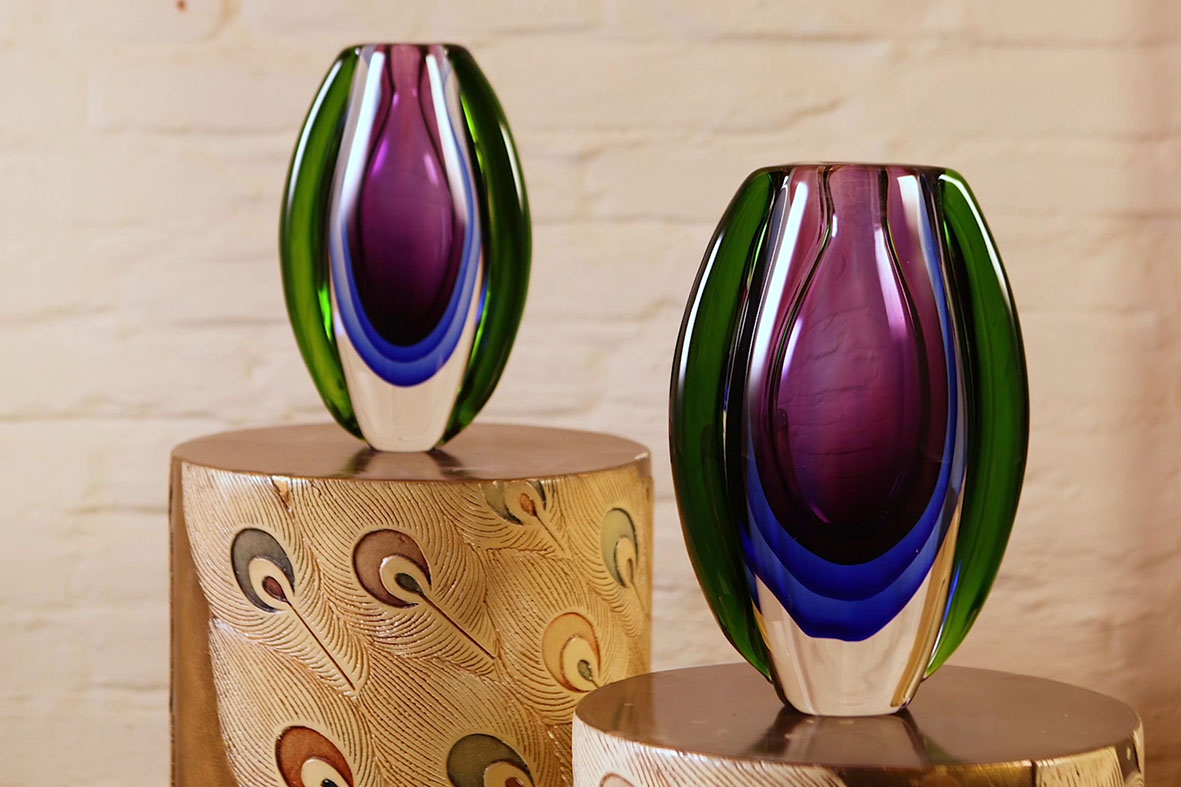
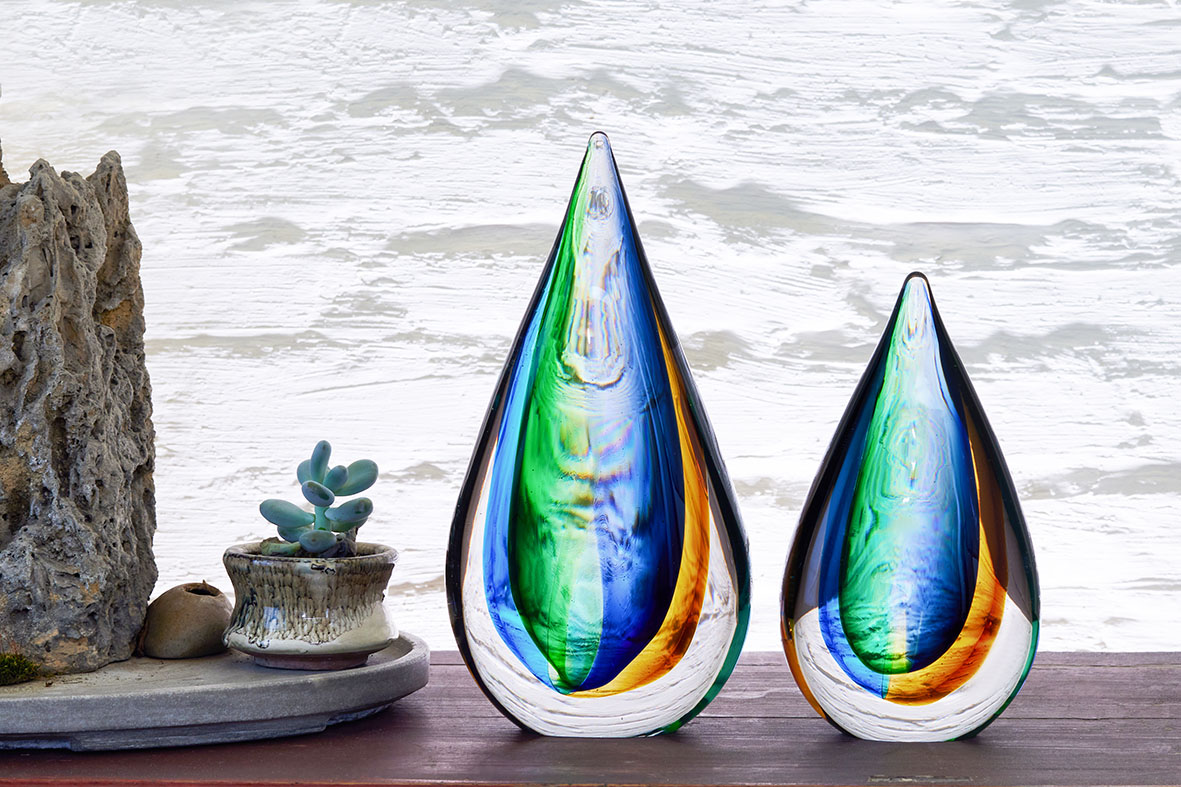
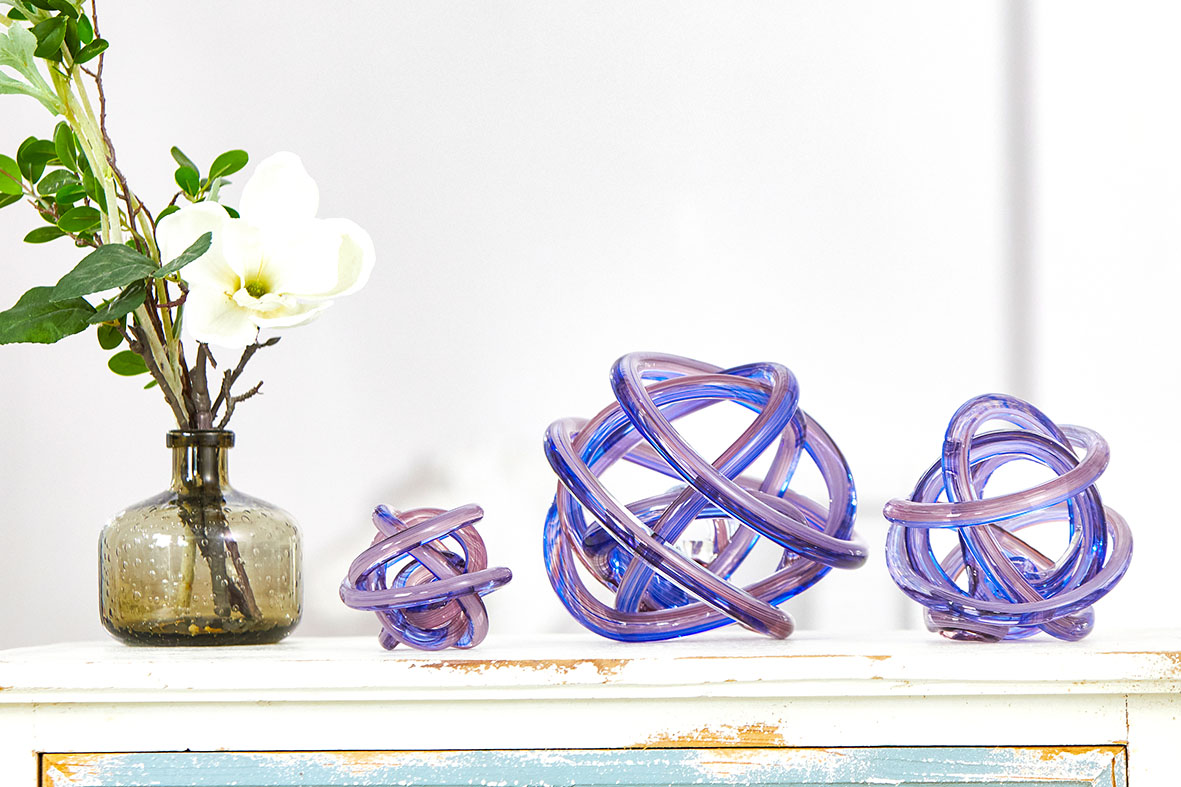
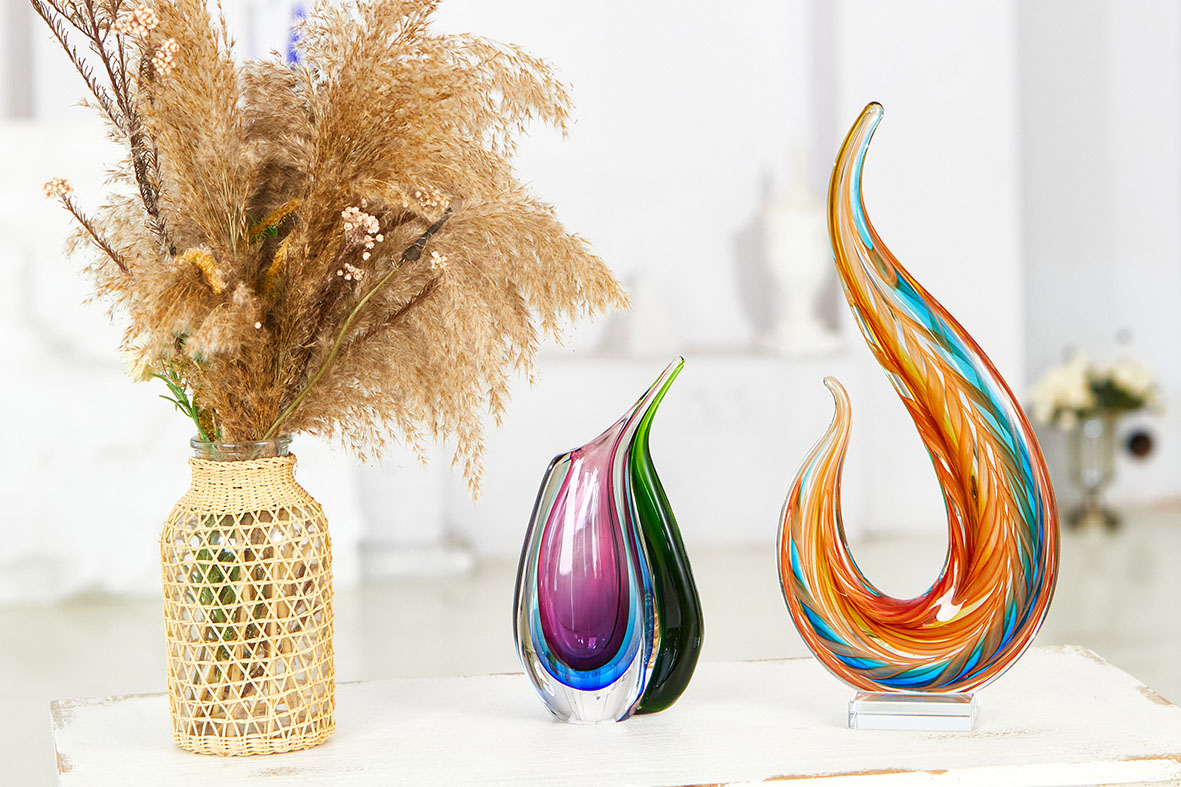
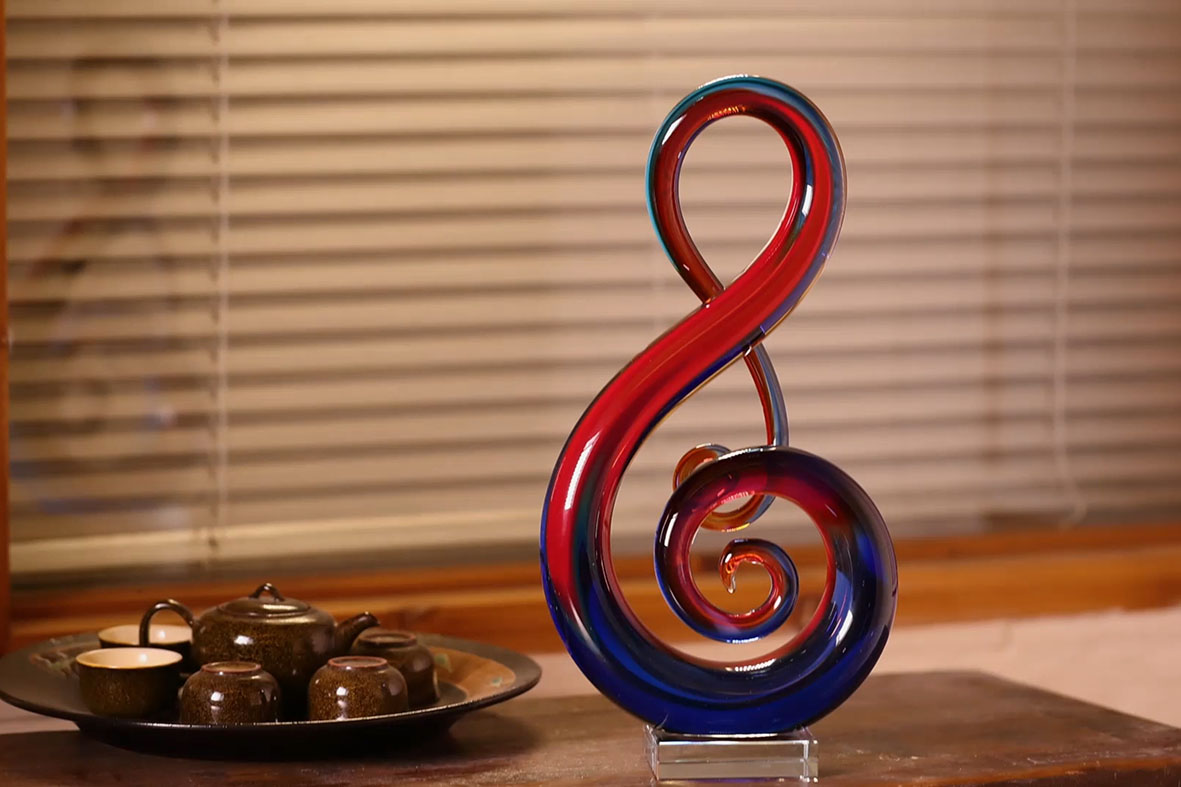
Several different sets were designed and built for this campaign rather than one — a distressed vintage-style console, window-lit interior scenes and a natural outdoor setting. That was a commercial decision: an importer selling a décor collection into several retail channels cannot use a single mood for all of them. The console set reads as an interiors boutique, the window light reads as a lived-in home, and the outdoor frames give scale against real surroundings, which is the thing customers most often get wrong when they buy glass online.
The lighting was built to get the colour out of the glass. These are cased pieces — colour layered inside clear glass — so the light has to travel through the object rather than bounce off it. Put the source in front and the piece goes dull and opaque with a flat white highlight stuck on it; bring the light round behind and beside it and the colour lifts and the interior layers separate. The edges then come from the tone immediately behind the piece, which is why the backgrounds here are light-coloured but never evenly lit: a brick wall, a textured plaster wall, window blinds. Each one gives the outline something to read against.
Colour was matched to the physical pieces, not to a reference image, because colour in glass changes with thickness — the same tint reads pale at a thin rim and deeply saturated through a heavy base, so the match has to be judged against the object in the hand. Hand-blown work also means no two pieces are identical, and we do not retouch that away. Dust, studio reflections and surface marks come out; the variation that is the entire argument for buying hand-made glass stays in. Two rounds of revisions are included, and the finished files were delivered as catalogue and e-commerce ready images for the US market.
Behind the Scenes
Campaign Imagery
What a campaign like this costs
Glass, mirror, polished metal and anything transparent carries a published premium over ordinary white-background work, because the lighting has to be built rather than set up. That per-image rate is the honest comparison point if what you want is catalogue images on white.
| Line item | Price |
|---|---|
| Glass, mirror, polished metal, high-gloss and transparent goods | US$70 per image, on pure white |
| Set building, props or an outside location | At cost, quoted before we book |
A lifestyle campaign is not a per-image job, so we quote it from your shot list rather than off a rate card: the studio days, the set build and the props are itemised separately and the set build is charged at cost, with the figure agreed before anything is bought. The published list for everything that does have a unit price is on our pricing page, with no enquiry gate in front of it.
Questions buyers ask about this kind of shoot
Why does glass cost more per image than our other products?
Because the lighting is built rather than set up. An opaque product can be placed into a lighting set-up that already exists; a transparent one changes the set-up, since the image depends on what is behind and beside the piece rather than on its surface. That is why glass, mirror, polished metal and high-gloss goods are published at their own rate instead of at the standard white-background price.
Can you do both the lifestyle sets and plain white listing images?
Yes, and doing them in one production is substantially cheaper than booking them separately, because the pieces are already here, already cleaned and already understood. The white-background pass is priced per finished image to marketplace specification — pure white, 2,000 px on the longest edge — and if a marketplace ever rejects a main image on specification we re-deliver it at no charge.
Our pieces are hand-blown, so every one is slightly different. Is that a problem?
It is the opposite of a problem, as long as nobody tries to hide it. We photograph the piece that was actually sent and match its colour to the object itself, so what the customer receives looks like what they saw. What we will tell you honestly is when a variation is large enough that one image cannot represent the whole batch — at which point the right answer is more than one image, not more retouching.
Where to go next
If what you need first is listing images rather than a campaign, the white-background and difficult-goods rates are published per finished image on our pricing page, to marketplace specification.
The rest of our campaign work is in the portfolio, product film and 3D animation are on the video production page, and the studio itself is described on our about page.
Planning a similar project?
Tell us about your products and we’ll prepare a production plan. Published prices are on our pricing page — no enquiry needed to see them.
Get a Free Quote